
Guest Article Disclosure: This article was submitted by UNITE-LA and is published as a guest contribution. The views, opinions, statements, and resources expressed in this article are those of the author and do not necessarily reflect the views, positions, policies, or endorsements of the Microenterprise Collaborative of Inland Southern California, its board, staff, funders, or partner organizations.
By Alysia Bell, President, UNITE-LA
Why workforce stability, strong customer demand and regional collaboration matter to Southern California’s economy
What Helps Microbusinesses Succeed
Ask a microbusiness owner what helps their business succeed, and the answer is often remarkably consistent: reliable employees, steady customers, dependable supply chains and the confidence to invest in growth. Whether it’s a neighborhood restaurant, child care provider, retail store or logistics company, small businesses depend on stable conditions that allow them to serve customers, retain employees and plan for the future.
Entrepreneurs and Workers Strengthen Local Economies
Across Southern California, immigrant entrepreneurs, workers and consumers are an essential part of that stability. They start businesses, fill critical workforce needs, purchase goods and services, and help drive economic activity throughout the region. Their contributions strengthen local economies, support job creation and help businesses grow.
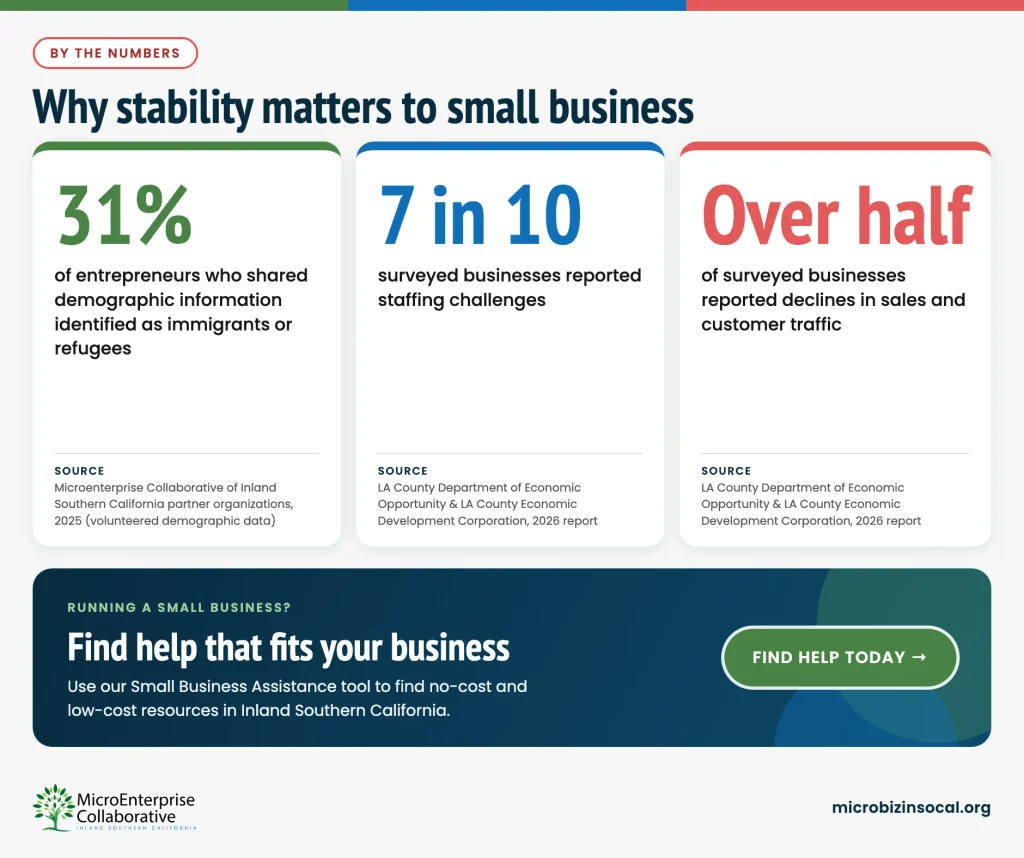
In the Inland Empire, the Microenterprise Collaborative of Inland Southern California (Collaborative) and its partner organizations support entrepreneurs from many backgrounds. Among entrepreneurs served through the Collaborative’s partner organizations who reported demographic information during 2025, 31% who volunteered information identified as immigrants or refugees. They own neighborhood businesses, create jobs, strengthen commercial corridors and provide services that communities rely on every day.
When Disruption Hits Microbusinesses
When businesses experience instability in their workforce or customer base, the impacts can be immediate. Reduced foot traffic, staffing shortages, delayed deliveries and disrupted operations affect revenue, productivity and growth. For microbusinesses operating on thin margins, even temporary disruptions can create pressure on cash flow and make it harder to retain employees, invest in expansion or meet customer demand.
Recent research underscores how quickly operational disruptions can affect local businesses. A 2026 report from the Los Angeles County Department of Economic Opportunity and the Los Angeles County Economic Development Corporation found that more than half of surveyed businesses reported declines in sales and customer traffic, while seven in 10 reported staffing challenges. The findings highlight the importance of stable access to workers, customers, transportation and business services, particularly for small businesses operating with limited cash reserves.
Business owners have seen these effects firsthand.
“People weren’t gone because they didn’t want to dine with us,” said Nayomie Mendoza of Cuernavaca’s Grill. “People were gone because they were afraid to be on the street.”
For many small businesses, a continuous decline in customer activity can be difficult to absorb. One florist featured in our employers’ stories described the challenge this way: “The streets are empty, my employees can’t get hours, and we’ve used everything we saved just to keep the lights on.”
A Connected Regional Economy
The consequences extend beyond individual businesses. Southern California’s economy is deeply interconnected. When child care providers struggle to staff classrooms, parents may be unable to get to work. When suppliers lose drivers, deliveries slow. When neighborhood businesses lose customers, fewer dollars circulate through local communities. Shared industries, supply chains and labor markets mean disruptions in one area can have consequences across the region.
Collaboration and Resilience Across the Region
Fortunately, Southern California also has a long history of collaboration and resilience. Employers, chambers of commerce, workforce organizations, educational institutions, lenders and public agencies regularly work together to help businesses navigate challenges and remain competitive.
The Collaborative was created with that goal in mind. By connecting entrepreneurs to technical assistance, business-support services, funding opportunities and workforce resources, the Collaborative helps strengthen business resilience and expand economic opportunity across the region. Business owners can start by searching our Small Business Assistance Tool to find no-cost and low-cost help.
A Resource for Business Leaders
As part of that effort, UNITE-LA developed the Business Leader’s Guide to the Immigrant Workforce, a resource that brings together economic research, employer perspectives, workforce information and practical guidance to help business leaders better understand the workforce dynamics shaping Southern California’s economy.
We encourage business leaders to explore the guide, share it within their networks and use it to support informed decision-making. We also want to hear directly from employers. Data helps identify trends, but business owners provide real-world insights that bring those numbers to life.
Building a More Resilient Regional Economy
Southern California’s economy is strongest when entrepreneurs can invest with confidence, workers can contribute their talents, and customers can fully participate in community life. By supporting entrepreneurs, strengthening workforce partnerships and investing in the conditions that help businesses thrive, we can build a more resilient regional economy that benefits everyone.
The entrepreneurs are ready to grow. The workforce is ready to contribute. The customers are ready to support their communities. Together, we can ensure they all continue participating fully in Southern California’s economy and helping drive regional prosperity.



 English
  Español de México